“I can confidently diagnose you as on the autism spectrum, with strong diagnostic impressions for autism spectrum disorder.”
I’m not sure I even registered the psychiatrist’s words. I must have because my body reacted viscerally and the next moment I was hunched over, shaking, sobbing, completely overwhelmed and in shock, crying in front of the doctor after nearly two grueling hours divulging my life’s history, on my 21st birthday no less.
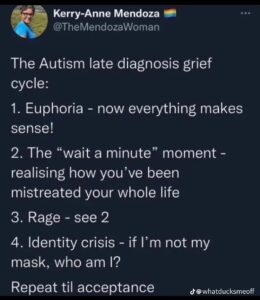
Relief, yes. Affirmation. That I wasn’t faking it. I wasn’t dramatizing or exaggerating. Recognition of glaringly overlooked signs. After an agonizing year of research (more of a culmination of two decades of reflection), of pleading with my parents to take me seriously, of talking to other neurodivergent friends, I finally received the answer I’d been searching for. This was real. Concrete. So why did I feel so heavy, so horribly displaced and insincere?
There is mourning. Grief for the girl I was before. It oscillates, from reassurance to invalidation to sorrow. I know, logically, that I am not any different than before, but something innate has shifted. I can’t go back to who I was. It’s impossible. That piece of myself is lost forever. The weight of knowing, the burden of confirmation. I wanted this validation, didn’t I?
I cried that night. I always cry on my birthday, a force of habit and gnawing existentialism, but that night I sobbed like I’d never sobbed before. Heaving. Wretched. I felt terrible. Like I had made a mistake. My parents seemed to brush aside their initial shock, but their eyes glistened with tears as I blew out candles. A sinking despair. I failed them. Ruined everything because I just had to know. I wanted to plead that I’m sorry, I’m still me, please don’t be mad. Please don’t hate me. I can be like how I was. But that’s a lie. And they knew it too.
In came the flood of mixed support. Invalidation. Confusion. Hatred. Anger.
What would my life have been like if someone had noticed early on? My mom literally sent a list of “quirks” to the doctor but couldn’t recognize that as I was growing up?
I’m screaming at a void of gender biases, cultural stigmas, and outdated diagnostic criteria that prevent early diagnosis. Me and every other late-diagnosed autistic female. I should’ve caught on sooner – several of my friends are also autistic or neurodivergent. Like the girls, gays, and theys, I guess we tend to naturally drift together or are grouped together by school systems, a la the “the gifted program” (Target in elementary school, Magnet STEM Academies/AP programs in high school – the gifted kid burnout to neurodivergence pipeline is so real.)
I acknowledge I have low support needs or level one ASD (previously called “high-functioning,” a misleading and harmful term), but this doesn’t negate the challenges I do face, they just might not be as apparent due to a variety of reasons (masking, gender, ethnicity). It’s a spectrum, after all, and not a linear one that leads people to falsely claim that “everyone is on the autism spectrum” but a radial spiked circular one like a color wheel, where everyone with ASD presents differently, and should receive accommodations as necessary. For instance, while I may not struggle as much with sensory processing issues or restricted interests and repetitive behaviors (I did more as a kid), I do struggle with social communication, executive functioning, and anxiety and mood disorders.
Even after my official diagnosis, my parents still questioned it, insisting that everyone experiences those same issues, that everyone has idiosyncrasies, and honestly, you only saw that psychiatrist for 2 hours, filled out paperwork, and took diagnostic tests, she can’t possibly know who you are.
But she doesn’t need to. She just revealed what was always there. What was always inherent.
I look back at the signs scattered throughout my childhood, little breadcrumbs leading to a heaping revelation.
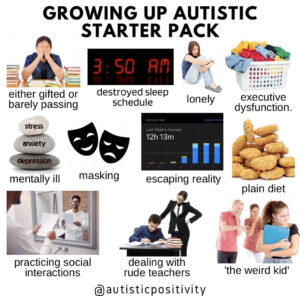
The pervasive feeling that something is fundamentally different, the terror of navigating social situations, not knowing when to speak, avoiding eye contact, struggling so hard to make and maintain friends, the excessive lining up of my Bryer horses or Playmobile or American Girls for hours and collecting items (plastic gelato spoons, plastic cutlery, travel soaps/shampoos, minerals), the food sensitives over texture or taste (I’d gag and throw up my food and refuse to eat things I didn’t like), the meltdowns from overstimulated environments (I couldn’t go to Times Square, the mall, the arcade or anywhere loud and crowded when I was young), the avid reading and desire for artistic expression (higher reading levels at a younger age), the executive dysfunction despite high academic performance, the rigid, black/white thinking and strong sense of justice, the preference for animals over people (my cats), struggles with interoception (going hours without eating, not knowing when I need to use the restroom), not liking any physical affection or contact (I refused to hug or let anyone hug me), the inability to cope with major life changes, the hyperfixations and special interests (various animals, horses, sharks, wolves, hedgehogs, dolphins, owls, cats, platypuses, sea turtles, snakes, manatees; Greek/Roman/Egyptian/Norse mythology, Harry Potter and fantasy, dystopias, the post-apocalypse, zombies, the environment), the struggles with rhythm, motor coordination, following specific instructions/steps, logical thinking, common sense, the need for decompression and alone time, taking things literally, people always saying you’re so standoffish, intimidating, blunt, or rude, and more.
I reflect on the first-year post-diagnosis. It’s been a long, long year, I can hardly remember the start, but that’s any year, right? We go through so many different experiences, relationships, identities that shape us. We’re constantly evolving, learning, screaming at an indifferent universe to notice us, to make something meaningful out of our insignificant lives.
I look to the future, and for the first time, there’s a glimmer of hope. My intersecting marginalized identities (I have a need to label and categorize myself into neat complexes – I’m adopted, Asian American, autistic, on the aro/ace spectrum, and queer) aren’t a deterrent or disadvantage but just layers of myself, like anyone else. For so long I’ve been so concerned and enraged by how vastly different I was from the dominant group or status quo, how these aspects instantly branded me as a minority and presented challenges, how tired I was from existing in a world not designed for someone like me. And I am. I am beyond frustrated at the lack of intersectionality, empathy, and understanding some people exhibit, that progress is laborious, and the burden of representation and education falls on those most affected. But I think my autism diagnosis has clarified these intertwined identities. They are no longer warring, demanding to be vindicated, but nuances to better understand myself and my perspective.
It’s honestly fitting that it took nearly 22 years to realize this. I wonder how long it will take for me to realize the next stage of my becoming.
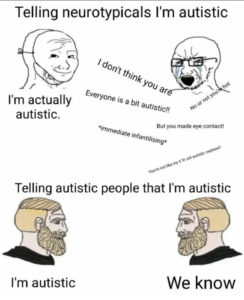
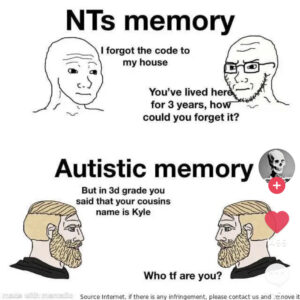
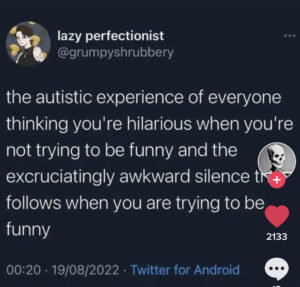
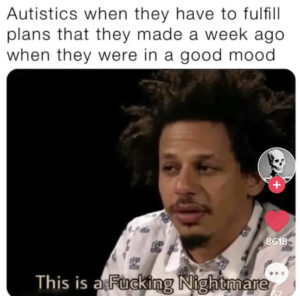
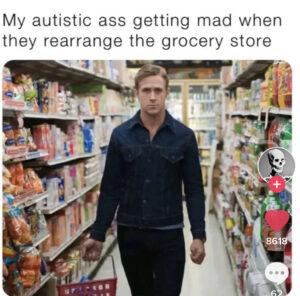
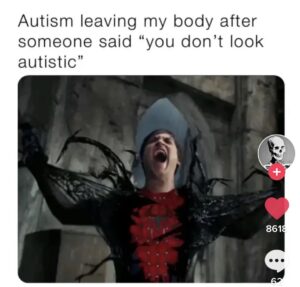
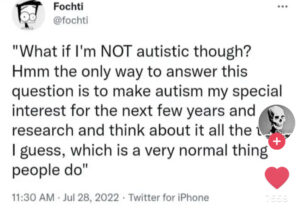
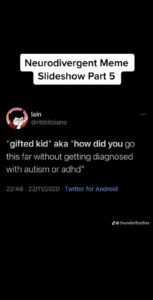
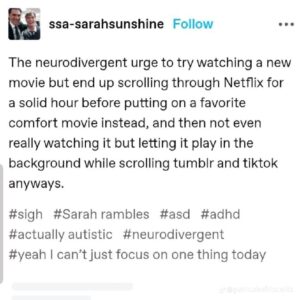
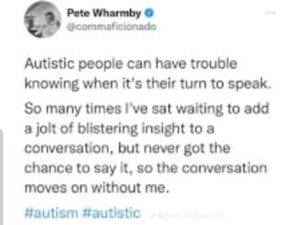
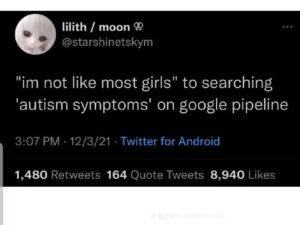
Anyway, here are some memes I find funny: